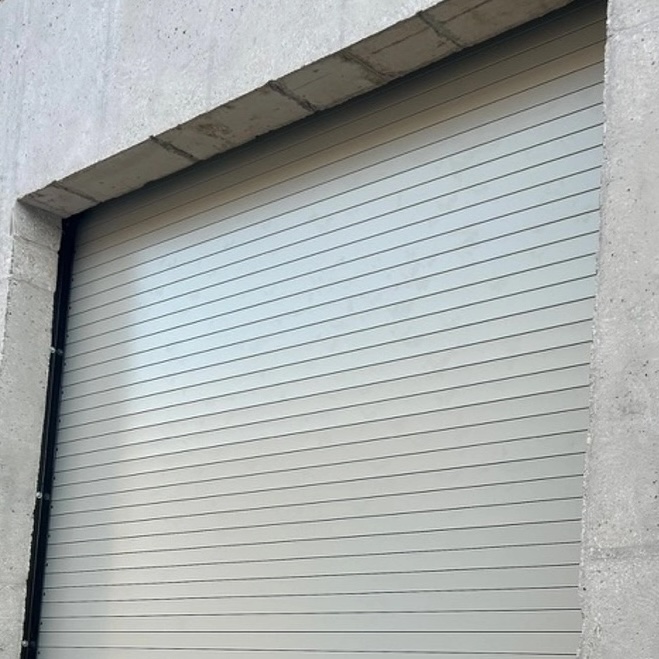
If there’s anything true about working in garage doors, especially commercial doors, it’s that every day you’ll run into something unique. That doesn’t even include people driving into a door (you’d be surprised how often this happens). This industry is just inconsistent in a way you just can’t imagine until you do garage door work every day.
You’ll end up with a job that seems like a standard door install or a basic repair, then you get on site and realize none of it lines up—at all—with any reasonable definition of what “standard” could mean. The opening, materials, headroom, immovable clutter, the wrong bolt for the wrong thing in the wrong place, because someone in a factory slipped up—you have to be a problem solver in this business. You just do, especially with commercial door systems and overhead doors.
Example Of A Commercial Door Repair
A good example of this is a 12-foot job we did in West Valley City. It seemed simple enough. But once we arrive, there’s no reverse angle. The beam was in the back. Door wasn’t too heavy but wait—5-6” of headroom was all we had to work with and we couldn’t use low headroom track. I mean it goes without saying, but without the right track you’d be saying “my door won’t go up”. Low headroom track would be the “normal solution”, but in this case we couldn’t. So, the job turns from “install this thing” to “figure out this, and that, and how that affects this”. It’s just not as simple as you’d think. If there’s a rulebook, it’s to use your head, get to work, measure, and get the facts beforehand, to have a daily procedure that gets fine-tuned to avoid a lack of clarity and future issues or problems.
We ended up cutting the tracks down by about 3 inches to fit the space we had. As there weren’t reverse angles, we reversed all the brackets just to make it work. It’s not just bolting stuff together. It’s making sure the door is going to run smoothly—the principle that governs… well, that should govern every decision in the garage door world. Any decent door tech is looking for a lasting install or repair. Sometimes that means cutting track. Sometimes it means a different operator or figuring out something custom. Our business runs because our customers trust us with their door, and our techs have to know their stuff. Really know it, including alignment, components, and overall performance.
The gist is that the door has a motor. The spring is wound with cables to help “lighten” the door. The motor pulls a lightened door. Over… and over… and over. Think about that. Repeating the same movement every day? This is where track and rollers come in. The track has to be the right kind of track, the right length, mounted right, and adjusted so that the rollers will run smoothly. It’s like anything with moving parts. The more parts, the more likely something is going to break. So when you install, sell, or repair anything for a living that involves movement (especially a lot of movement, frequently used, lifting a heavy door) you have to do your due diligence to make sure “it’s working now” will mean “it’s going to keep working”, especially for rolling, rollup, and steel door systems.
How To Make Commercial Roll Up Door Repair Go Smoothly
- Know how wide and tall your door is.This does help a technician to know in advance, so if you can provide this information, you’ll be helping the tech have info that tells them a little of what to expect. They’ll certainly be able to rule out things like which springs won’t be used, etc, and plan for proper inspection and maintenance.
- Remove clutter. When there’s less space to work with, we can often make it work, but it can also slow technicians down. If you’re in a rush, this is very important, especially when dealing with large commercial doors or overhead systems.
- Call after hours. Forget what the hours say. Even if someone can’t make it until morning, there’s no point in delaying scheduling a repair or service for a broken door.
- Talk is fine, but it can delay things. If you’re in a hurry, as long as we have a clear idea of what you want done, what to repair, or not to (and we’ll check with you if anything comes up that would change the install/repair), then that puts in a spot to get it done sooner and avoid further damage or safety issues.
- Send pictures. I cannot stress this enough. What may seem unimportant or unusual to you might be the one thing that tells us key things about your door situation. This is a huge help, especially for diagnosing problems with tracks, slats, springs, or the motor.
Having The Right Hardware
Repairing commercial garage doors isn’t like the door on your house. There’s overlap, but bigger and heavier doors can (and usually do) mean a different set of hardware: bigger springs to lift a heavier door, and larger garage doors like shop doors (auto shops, warehouses, etc) even have different types of rollers, operators, and rolling steel components.
You definitely don’t have to know about different types of track, brackets, and more. Just know it’s a different ball game and that you want a tech who has experience in commercial doors. Our techs either have the experience or accompany someone who does until they can lead an install or repair, including repairing complex commercial door systems.
Just Looking For Improvements
It’s worth saying a service call doesn’t have to mean waiting until problems arrive. We can “enhance” your door in several ways, from weather-proofing, insulation, to reinforcing the door for better security and performance.
What these look like:
- For weather, we can add vinyl seal, astragal / bottom seals which keep water and critters out, seal for roll-ups, and more. We stock brush seal, for example, for roll-ups and rollup doors.
- Hardware upgrades can look like replacing or moving components. Rollers and hinges are the most common, so we apply a silicone lubricant to them on any door that needs it as standard practice during routine maintenance.
Commercial Roll Up Door: Repair Or Replace?
This is going to come down to functionality and cost. If the door doesn’t function, we’ll look at how much has to go into making it work. If that cost is enough that you should start considering a replacement, we’ll let you know what both options look like. This is a case where pictures are very helpful. Sometimes, with certain kinds of hardware for example, we can look at a picture and immediately know we’ll need to bring something specific on the job.
In some cases, repairing broken components like springs, slats, or a failing motor is enough. In others, replacement is the better long-term call for safety, security, and avoiding repeat issues or problems.
As you can see, I can ramble on about doors. It feels good when we can step back and say “we helped this person out” and know that we did good and honest work. We’re not a big national chain. We’re Utahn. So we want to do it right.